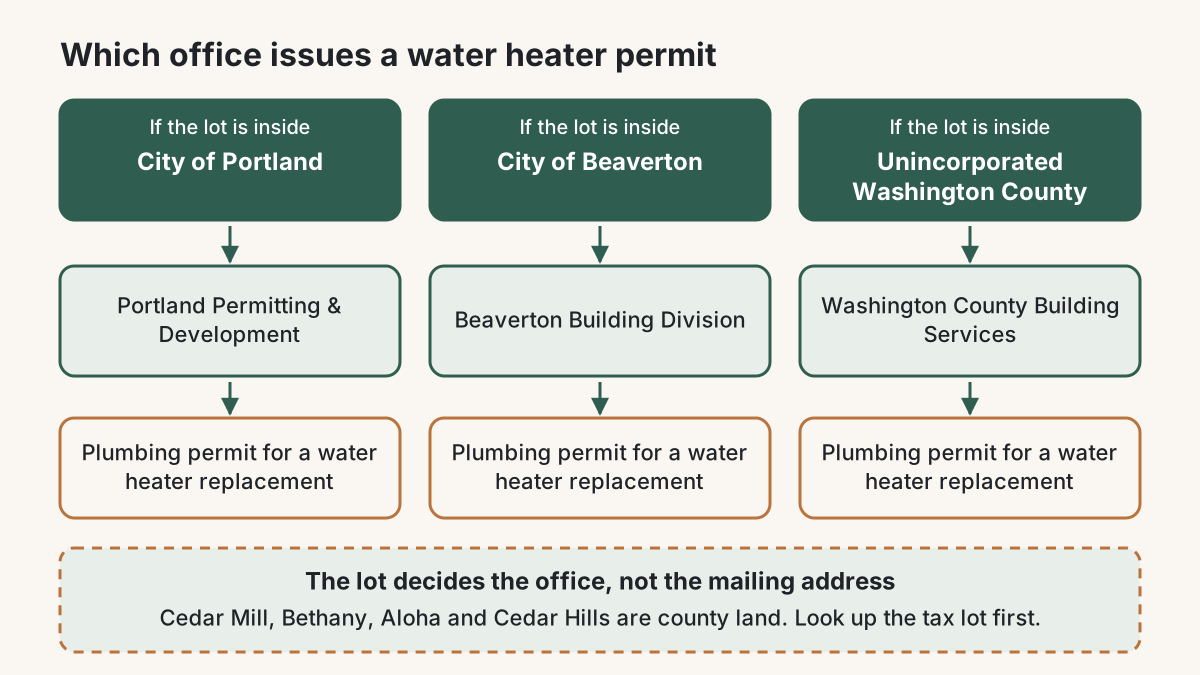
Yes. In Oregon a water heater swap needs a plumbing permit, even when the new tank matches the old one in size and goes in the same spot on the same pipes. The state counts a water heater as a pressure vessel. On the west side, Portland, Beaverton or Washington County issues that permit, depending on the address, and an inspection comes with it.
Sources: the state Building Codes Division plus the Portland, Beaverton and county permit pages, read November 2026.
Do you need a permit to replace a water heater in Oregon?
You do, for gas and electric alike, like for like included. The Building Codes Division names water heater replacement among the plumbing jobs that need a permit, and its reason is plain: a pressure vessel set up wrong can fail hard, not just drip.
People expect the heater to sit with the small stuff. Swapping a faucet, a toilet or a sink that isn't hidden inside a wall takes no plumbing permit in Oregon, and Washington County leaves ordinary minor repairs alone too. The tank is on the other list.
You'll read online that a plumber told someone "no permit needed for a straight swap." That may be true in another state. Oregon's permit pages carve out no such exception. If you're weighing replacing a worn-out tank, plan on the permit from the start.
Which office handles a west-side address?
It's decided by where the lot sits, not by what the envelope says.
| If the house is inside | Ask | Water heaters on its page |
|---|---|---|
| Portland city limits | Portland Permitting & Development | "Replace a water heater" is on its plumbing-permit list |
| Beaverton city limits | The city's Building Division | Issues plumbing permits; no separate water heater page, so the state rule governs |
| No city (unincorporated county) | Washington County Building Services | Lists water heater replacement as plumbing-permit work; its FAQ speaks only for unincorporated lots |
Here's the trap on our side of town. Cedar Mill has no city government and no ZIP code to call its own. It's part of the county's urban unincorporated land, together with Bethany, Aloha and Cedar Hills. So a house with a "Portland" or "Beaverton" mailing address can still be a county permit, and Beaverton has pulled some pockets into the city over the years. Look up the tax lot before you call anyone.
The same office question comes up with decks, fences and other repairs. That's covered in our general permit guide.
Is it legal to replace your own water heater?
Yes, if you own the house and you get the permit. It doesn't excuse that work from inspection.
The local pages add conditions. Portland wants you on the county's records as the owner, and it says outright that an LLC doesn't count. Washington County lets an owner do the plumbing in their own single-family house or duplex, but a friend, neighbor, tenant or general contractor can't step in unless that person is a plumber employed by a plumbing business.
Rentals are different in Portland. If you manage rentals, our page for landlords covers the rest of a turnover.
Who pulls the permit when you hire someone?
In Oregon, whoever does the work, owner or contractor, answers for the permit. Hire someone and that duty is theirs.
A plumbing contractor has one more option. In place of a local permit, it can buy a state minor label for a water heater job in a single-family house or duplex, up to three heaters. The label includes one inspection, and only a installer may use it: a Journeyman Plumber or a Water Heater Installer.
A Water Heater Installer can set a new heater on the plumbing that's already there, with no move to a new spot and no changes to the pipes. It can't do the swap at all if the house has no cold-water shut-off.
So with any bid in hand, ask one thing: label or local permit? Either way you should see an inspection on the paperwork. For the wider picture of which trade may do which job, see who can legally do what in Oregon.
Does switching to tankless, heat pump or a different fuel change the permits?
It can. The swap itself is a plumbing permit in Oregon. Other permits get added only when something besides the heater changes.
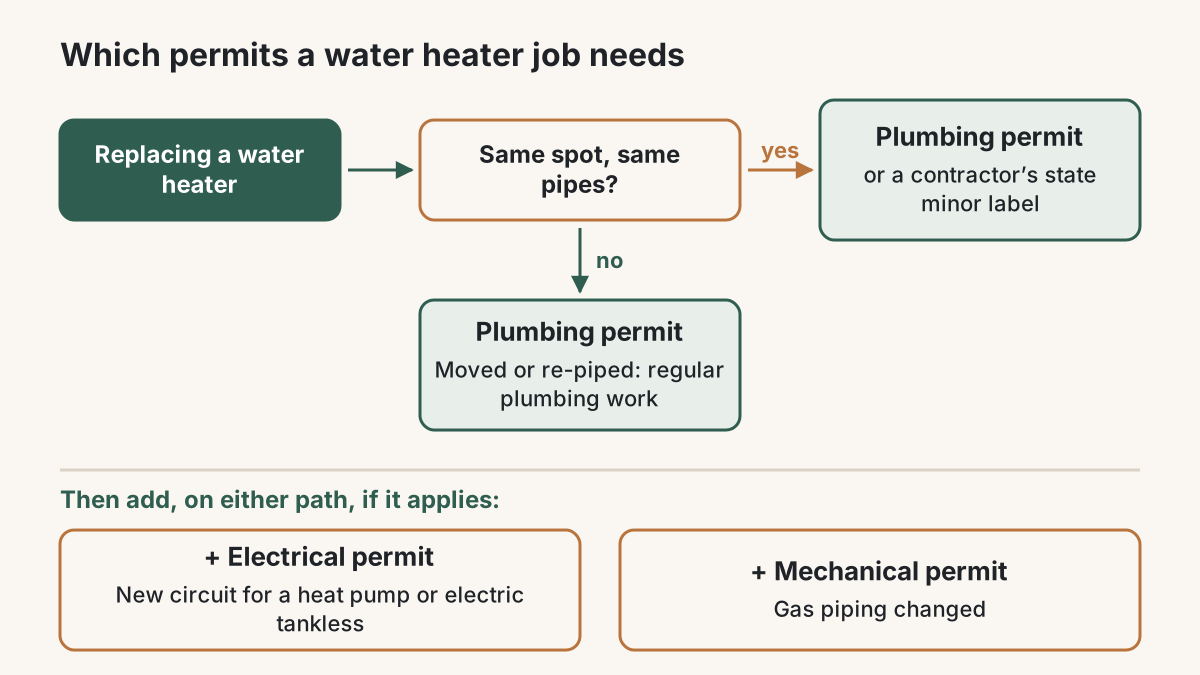
Moving the heater, or reworking the pipes to fit a new unit, puts the job outside the Water Heater Installer's scope. It's then regular plumbing work under a plumbing permit. A heat pump unit or an electric tankless often wants a new or bigger circuit, and new or altered permanent wiring needs an electrical permit on top.
Gas piping is a third permit, a mechanical one. We don't do gas line connections, so that part goes to a gas-qualified trade.
What does the inspector check after a replacement?
Oregon has a statewide interpretation written for this exact case, No. 2002, revised on the first of October 2026. It tells inspectors which code items to bring current when a tank gets swapped.
If the heater lives in a garage, it has to be raised off the floor. It needs seismic straps or anchors, and our water heater strapping guide explains what that looks like. The inspector will look at where the relief-valve line ends, whether there's protection against thermal expansion, and, on a gas unit, whether the heater gets enough combustion air.
The same interpretation names things a plain swap doesn't force on you. You don't have to add a drip pan, resize the water pipes, or fix house pressure that already runs over 80 psi. If yours is in the garage, the raise is often what changes the install most, so check that first.
How much is the permit?
Each office sets its own fees and updates them every July, and an installer's price may or may not include the permit, so ask. The figures we read in November 2026 are in our cost guide for water heater swaps.
What if the water heater fails and you need a new one today?
Under Oregon law (ORS 455.058), a city, county or the state may add a fee when permit work begins before the permit is issued. That fee equals what it costs the office to look at the work after the fact.
There's a carve-out that matters here. The fee doesn't apply to an emergency repair when the permit is obtained within five business days. Whether a split tank flooding a closet counts as an emergency is the office's call. Either way, apply inside those five business days and keep the receipts.
What if your current water heater went in without a permit?
Unpermitted plumbing tends to surface when the house is inspected for a sale. If you're getting ready to list, our pre-sale repairs page covers what buyers' inspectors flag.
The next replacement gets a permit regardless of the old one's history. At that inspection the garage raise, straps, relief line, expansion protection and combustion air are checked on the new tank. If the old one is close to the end anyway, signs a water heater is near the end can help you decide whether to wait.