
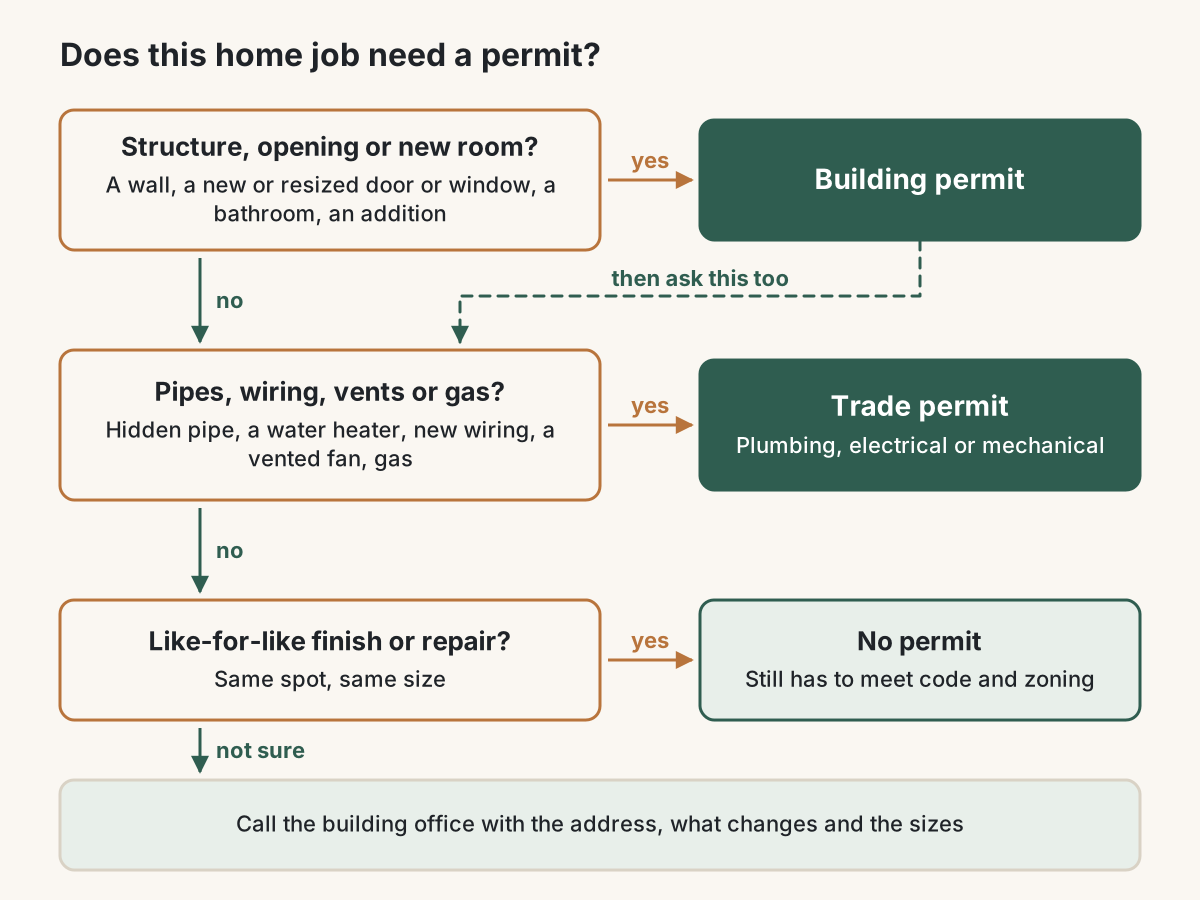
Usually not, if you're swapping old for new in the same spot. Oregon's house code lets you paint, lay floors, hang cabinets, fix siding, refit a same-size window or build a deck under 30 inches with no permit. Moving a wall, cutting an opening, adding a bathroom, changing a water heater or running new wiring all need one. Which office you ask depends on where your lot sits, not on your mailing address.
Checked against the 2026 Oregon Residential Specialty Code (in force since October 1, 2026) and the Portland, Beaverton and Washington County permit pages on November 8, 2026.
What home repairs don't need a permit in Oregon?
"Trade permit" means plumbing, electrical or mechanical.
| Job | Building permit? | Trade permit? | The catch |
|---|---|---|---|
| Paint, tile, carpet, floors, cabinets, countertops, shelves | No | No | Moving the sink is plumbing |
| Drywall, siding | No | Unless the wall must be fire rated | |
| Door or window into the same opening | No | A header or stud change needs one | |
| Gutters, insulation, masonry patching | No | Portland: gutters maybe, for stormwater | |
| Closet or other non-bearing wall | No | Not if it makes new living space | |
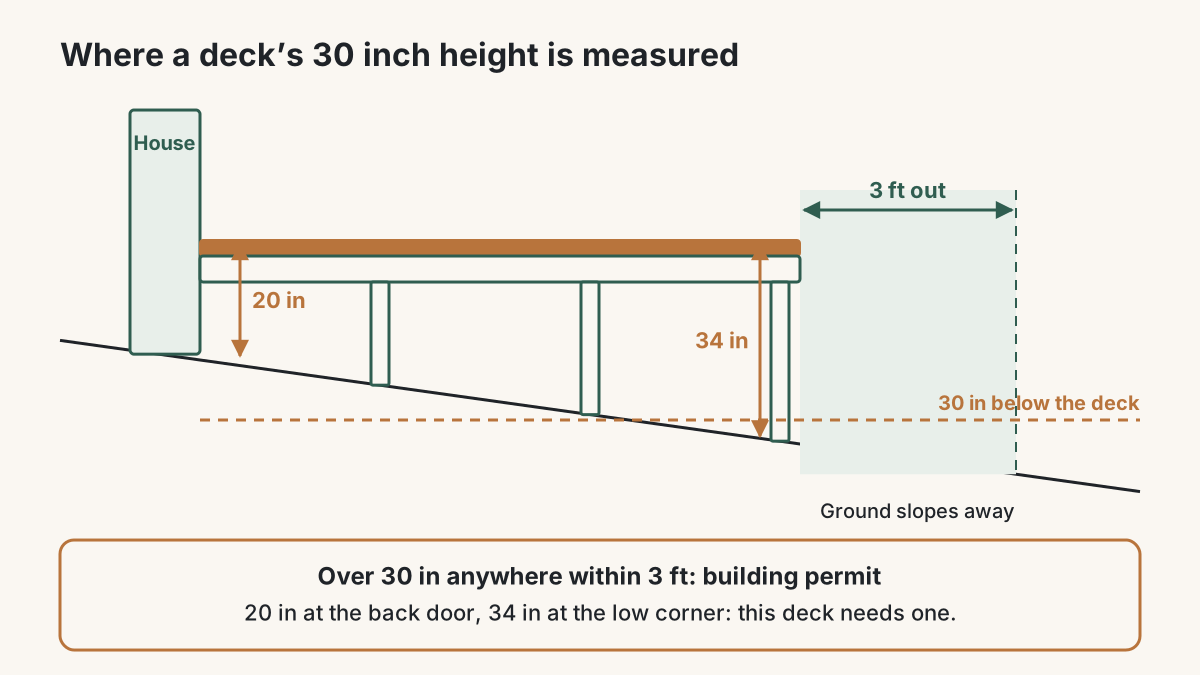
| Deck or porch 30 in or lower | No | Measured anywhere within 3 ft of the deck surface | |
| Shed up to 200 sq ft, 15 ft tall, nobody living in it | No | Electrical, if wired | 400 sq ft on 2+ acres |
| Wood, wire or chain-link fence 7 ft or less | No | Pool fences always need one | |
| Broken outlet, switch or light, same kind | No | ||
| Exposed faucet, sink or toilet | No |
Skipping the building permit doesn't skip the trade permit, and exempt work still has to meet code and zoning.
Which home projects always need a permit?
Building permit: taking out, moving or adding a wall; cutting a new door or window, or resizing one; turning a garage, attic or basement into a room; adding a bathroom; an addition; a shed over 200 square feet; a deck or entry stair over 30 inches; a fence over 7 feet; closing in a porch or carport.
Plumbing permit: a new water heater, pipe hidden in a wall, ceiling or floor, moving fixtures, or replacing more than 5 feet of concealed pipe after a leak.
Electrical permit: new circuits, added outlets or lights, fuses to breakers, a GFCI outlet repair, alarm wiring.
Mechanical permit: vented heating and cooling, wood stoves, gas lines, and installing a bath fan, dryer vent or range hood that exhausts outside. We don't do gas or HVAC work.
A bathroom refresh with the fixtures left in place is usually permit-free. Move them or add a bathroom and you need plumbing and building permits, and Portland says electrical and mechanical can follow. More on our bathroom remodel page.
Who issues the permit: Portland, Beaverton or Washington County?
| If the house is inside | You ask | Worth knowing |
|---|---|---|
| City of Portland | Portland Permitting & Development | Free 15-minute talks on whether you need one |
| City of Beaverton | Beaverton Building Division | Building, plumbing, heating/cooling and electrical |
| Unincorporated Washington County | Washington County Building Services | Its FAQ answers only for addresses outside city limits |
Cedar Mill isn't a city and has no ZIP code of its own, the Cedar Mill News explains; it sits in the county's urban unincorporated area with Bethany, Aloha, Cedar Hills and Raleigh Hills/Garden Home. So a "Portland" or "Beaverton" address on the mail can still answer to the county, and since Beaverton has annexed a few pockets, neighbors can deal with different offices. Give the office your street address before you start.
Do you need a permit for a deck, fence or shed?
Decks. The 2026 line is 30 inches above the ground, checked at any point within 3 feet out from the surface. On a hillside lot, a deck 20 inches up at the back door can be 34 inches up at the low corner, and then it needs a permit. Setbacks and Portland's environmental zones still apply. Most Portland-area builds of about 300 square feet run $10,000 to $30,000, around $16,000 typical, with materials and without permit fees (market data, November 2026) . See deck building.
Fences. Wood, wire mesh or chain link up to 7 feet needs no permit, and under the 2026 code no city or county can set a lower trigger for those materials. Zoning height and setback limits still count. See fence installation.
Sheds. One story, nobody sleeping or cooking in it, 200 square feet and 15 feet or less: no building permit. Wiring it takes an electrical one; using it as a room takes a building one.
Do you need a permit to replace windows, doors, siding or a roof?
A window or door in the same opening needs none. Widen or narrow it, or touch a header, and it does, so swapping a window in an old ranch house for a patio slider is permit work. Our window replacement page covers the same-opening kind. Siding needs no permit unless that wall has to be fire rated.
Roofs changed in 2026: a re-roof, damaged sheathing included, needs no permit if it adds 4 pounds per square foot or less. Townhouses, built-in solar shingles and houses first built under a local wildfire standard still need one, as does a re-roof inside Portland's mapped Wildfire Zones.
Do you need a permit for plumbing or electrical work?
Exposed faucets, sinks, toilets, shower heads, hose bibs and regrouting don't. Portland adds resetting a toilet for new flooring and an emergency fix of up to 5 feet of hidden pipe.
A water heater always needs a plumbing permit; the state calls the tank a pressure vessel. Most Portland-area replacements run $880 to $2,000, about $1,350 typical, with materials and without the permit fee (market data, November 2026) . See water heater replacement.
A like-for-like swap of a dead outlet, switch, light, breaker or doorbell needs no electrical permit; new wiring or added fixtures do. In Portland you can do permitted electrical work yourself only in a house you own and live in.
What happens if you skip a permit in Oregon?
ORS 455.058 lets the city, county or state charge an investigation fee when permit work starts first; it covers checking the work afterward, which can mean opening walls.
Emergencies get a window. If a windstorm drops a fir limb through the roof, the fee doesn't apply when you get the permit within five business days, and temporary shoring needs notice to the building official within 72 hours. See storm damage repair. Unpermitted work also tends to show up in a buyer's inspection; see home inspection repairs.
Who can apply for the permit, you or your contractor?
The state puts the duty on whoever does the work, and the permit stays on site for the inspector. Washington County lets owners plumb their own one- or two-family home; anyone else must be a plumber with a plumbing business.
How do you check before you start?
Zoning first: code says how to build, land-use rules say whether you can. Then call: Portland General Inquiries, 503-823-7300; Washington County Current Planning, 503-846-8761; Beaverton's Building Division lists contacts on the city site. Bring the street address, what changes, and the sizes (height off the ground, square feet, opening width). A permit lapses if work doesn't start within 180 days or stops for 180.