Oregon's plumbing code requires every storage-tank water heater to be anchored or strapped so it stays put in an earthquake. The state accepts metal strapping, including plain plumber's tape, as long as washers sit under the fasteners and the screws or anchors meet a stated size. Most 40 to 50 gallon tanks end up with two straps, one high and one low, pulled tight to a wall.
If yours looks loose, missing or half done, a ten-minute look with a flashlight will tell you a lot. Below is what the state wrote down, what it didn't, and how to check your own tank.
Does Oregon require water heater straps?
Yes. Section 507.2 of the Oregon plumbing specialty code says storage tank water heaters must be anchored or strapped. The state's building codes office spelled out what that means in Statewide Code Interpretation No. 15-03, last updated October 1, 2026. An interpretation like this is binding across Oregon, so inspectors in Washington County and Portland read the rule the same way.
The reason is not abstract here. The last big Cascadia Subduction Zone quake struck on January 26, 1700, at an estimated magnitude 9.0, and the state says Oregon can see one that size again. A tank that tips can tear its own water and gas connections loose. If you'd rather hand the job off, our page on strapping an existing heater or a new one covers the work itself.
What kind of strap and screws does Oregon accept?
Most search results for this question come from California, and they repeat California habits as if they were universal. Oregon's written minimum is lighter on some points and more specific on others. Here is how the two line up.
| Item | Oregon's written minimum (Interpretation 15-03) | What California-focused pages tend to say |
|---|---|---|
| Strap | Metallic plumber's tape or an equivalent strap is acceptable | Heavy steel strap, often 22 gauge or thicker; plumber's tape described as not good enough |
| Washers | Required on the connectors | Rarely mentioned |
| Into wood | No. 12 wood screw with 1½ in. of penetration at each end | ¼ in. lag screws into studs |
| Into concrete | ¼ in. diameter concrete anchor, at least 1½ in. long | Masonry anchors, size varies by city handout |
A minimum is just the floor. Pre-made strap kits with heavier steel bands are common in hardware stores, and many people use them because they're easier to tighten evenly. On a permitted install, the inspector who signs off has the last word on what passes.
Where should the water heater straps go?
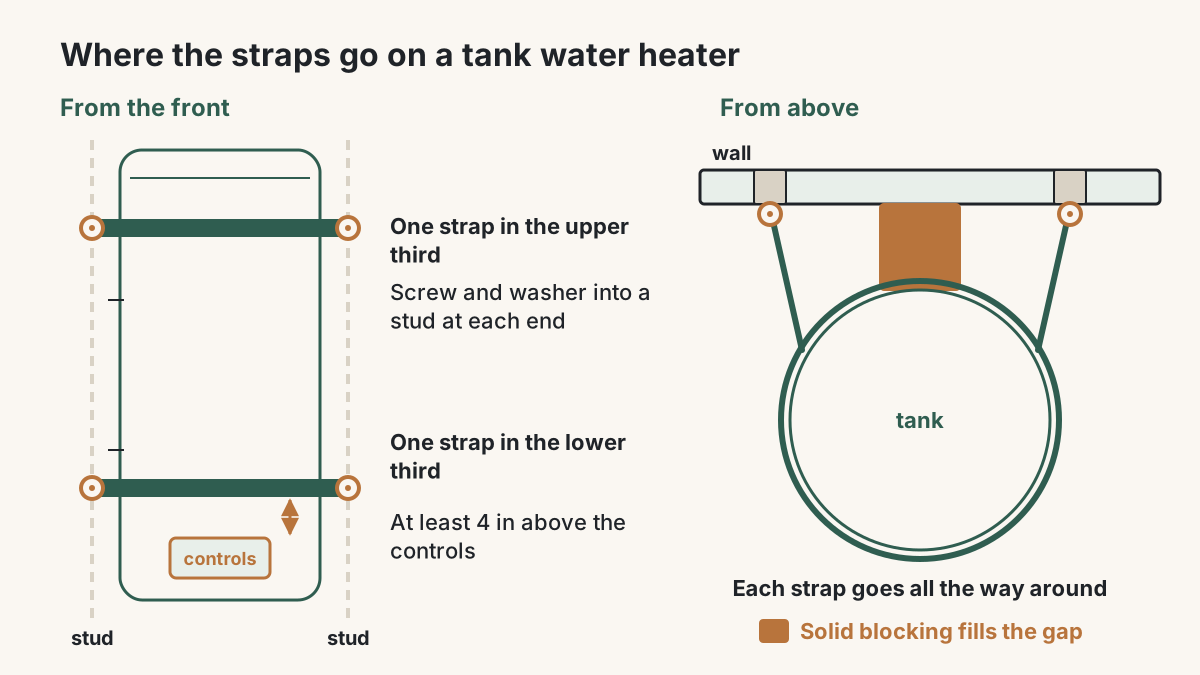
Oregon's interpretation doesn't give a height. The placement that inspectors and kit instructions use is one strap in the upper third of the tank and one in the lower third. The lower strap stays at least 4 inches above the gas valve or the lower thermostat cover, so a tank that shifts can't shear off its controls.
Each strap should go all the way around the tank, not just across the front. Both ends need to land in something solid: a wall stud, added wood blocking or concrete. Drywall on its own won't hold a full tank that wants to move.
If the tank stands a few inches out from the wall, that space lets it build up speed before the straps catch it. The usual fix is solid blocking between the tank and the wall so it can't rock back.
How many straps does a water heater need?
For the common 40 or 50 gallon tank, two. Strap kits and the California handouts call for a third strap in the middle on bigger tanks, roughly 52 to 75 gallons. Anything past 75 gallons is worth asking the building office or following the tank maker's instructions. None of these counts is written into Oregon's interpretation; they're standard practice.
The reason for more than one strap is weight. Water runs about 8.34 pounds a gallon, so a full 50 gallon tank holds around 417 pounds of water before you count the steel and the insulation. One strip of tape around the middle of that is a hinge, not a restraint.
Do electric, heat pump and tankless water heaters need straps?
Oregon's wording is "storage tank water heaters," and it doesn't mention fuel. An electric tank is a storage tank. A heat pump water heater is also a storage tank, usually a tall and heavy one. Both get strapped the same way as a gas unit.
A tankless heater is different: there's no tank to hold back. It hangs on the wall from its own bracket and goes up per the maker's installation manual. If you have a gas tank and the connector looks stiff, kinked or corroded, that's a question for a plumber or the gas utility, not for a strap.
How do you check your own water heater straps?
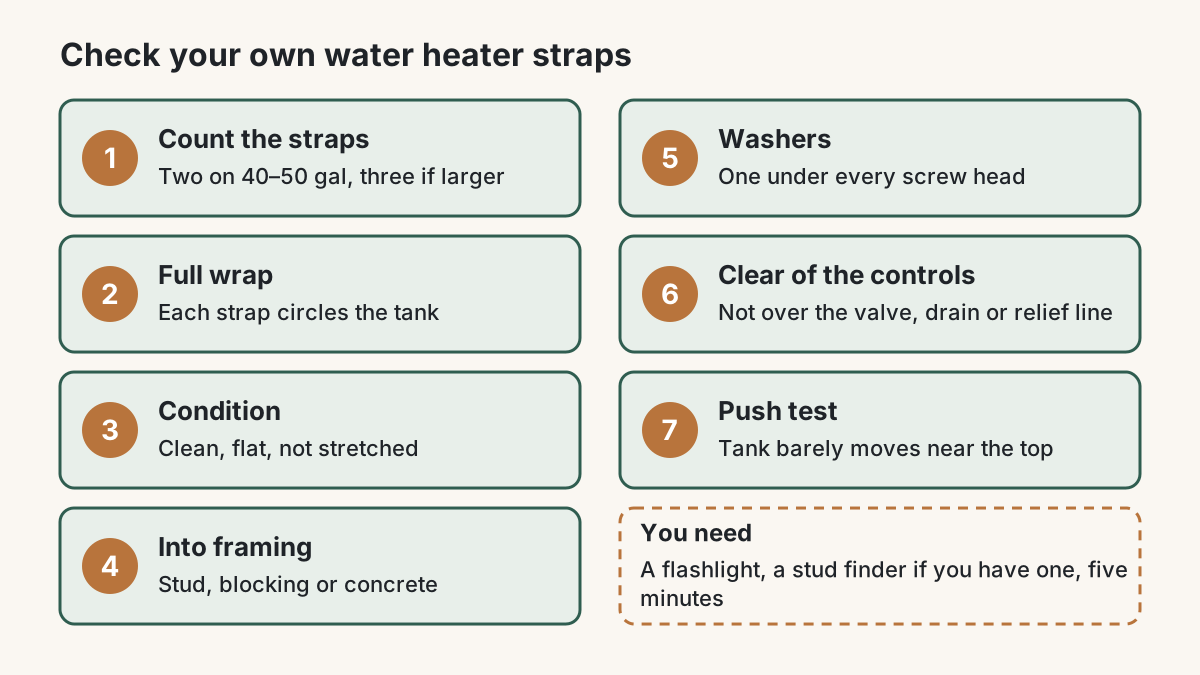
You need a flashlight, a stud finder if you have one, and five minutes. Go down the list.
| Check | What good looks like | What to do if not |
|---|---|---|
| 1. Count the straps | Two on a 40-50 gallon tank, three on a larger one | Add the missing strap |
| 2. Full wrap | Each strap circles the whole tank | Replace partial or front-only straps |
| 3. Condition | Metal is clean, flat and unstretched | Swap rusted, kinked or torn straps |
| 4. Fastening | Screws go into a stud, blocking or concrete | Move to framing or add blocking; a hollow knock means drywall only |
| 5. Washers | A washer under every screw head | Add washers so the strap can't pull over the screw |
| 6. Clearance | Nothing crosses the controls, drain valve or relief line | Reposition the strap |
| 7. Push test | The tank barely moves when you push near the top | Tighten the straps or add blocking behind the tank |
Heaters on west-side homes often sit in garages, hall closets or small utility rooms. In a garage, a tank on a raised stand needs the stand and the tank held as one unit, or the whole thing can walk off the platform.
Home inspectors flag this often. A Portland-area inspector writes that he points out missing straps to agents, and a nonprofit inspection group in the region calls poorly strapped heaters a common defect. If a report on your house lists it, our notes on fixing home inspection items can help you sort which items come first.
Does a new water heater get its straps inspected?
Replacing a water heater needs a plumbing permit in Washington County and in the City of Portland. The state's Interpretation No. 2002 lists seismic strapping among the code items that still apply when an old heater is swapped for a new one. So on a permitted replacement, the final inspection is where the straps get looked at.
Rules can differ by jurisdiction, so check with the permit office for your address. The basics of when work needs a permit are in this permit guide.
What does it cost to strap or re-strap a water heater?
Strapping an existing tank typically runs $150 to $400 in the Portland area, about $250 for most, labour only (market estimate from local hourly rates, November 2026) . Straps are the cheapest part of getting a house ready for a quake. The bigger jobs are bolting the frame to the foundation and bracing the cripple walls, which our seismic retrofit page and the Oregon Earthquake Brace + Bolt guide explain.