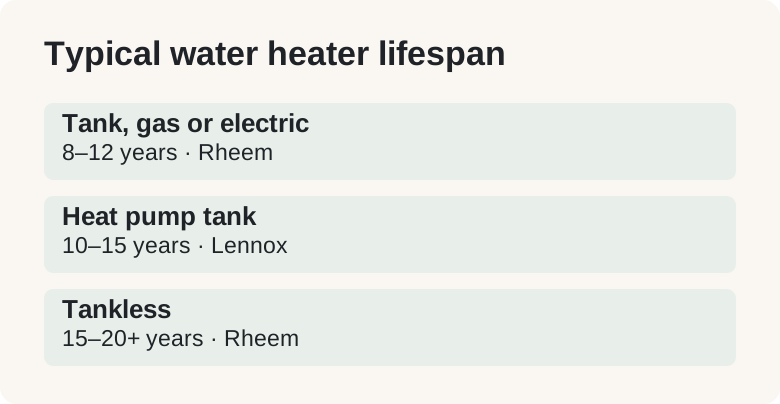
A standard tank water heater usually lasts 8 to 12 years, going by the manufacturers' own numbers, and a tankless unit can run 15 to 20 years or more. Your tank's age is the first clue. Rusty hot water, a rumble while it heats, or water under the tank means it's time to price replacing a water heater before it quits on you.
How long does a water heater last?
Rheem puts an ordinary tank at 8 to 12 years and a tankless heater at 15 to 20 or more with proper care. Lennox gives heat pump (hybrid) tanks 10 to 15 years. Those are the makers talking about their own equipment, so treat them as a fair middle, not a promise.
| Type | Typical life, maker's figures | Source |
|---|---|---|
| Tank, gas or electric | 8-12 years | Rheem |
| Heat pump (hybrid) tank | 10-15 years | Lennox |
| Tankless | 15-20+ years | Rheem |
Why such a wide spread? Gas versus electric matters less than people expect. What wears a tank out is the water inside it, how hard the household works it, and whether the anode rod still has anything left to give. A 50-gallon tank doesn't outlive a 40-gallon one just for being bigger, since both are built the same way.
Can one last 20 years? Some do. It's the lucky exception, though, not a reason to put off planning a replacement. And the warranty length tells you what the maker is willing to cover, not how long your particular tank will hold out.
Does Portland's soft water make a water heater last longer?
Most lifespan articles online blame hard water for short tank life and end up recommending a softener. That advice is written for other parts of the country. The Portland Water Bureau's 2026 report puts Bull Run water at about 7 to 11 ppm of hardness, roughly half a grain per gallon, which is very soft. The groundwater Portland sometimes blends in is harder, about 80 ppm or around 5 grains per gallon, and still only moderately hard.
In plain terms, a lot less mineral scale settles on the bottom of a tank here than in a city with hard well water. So the "flush it every six months" routine and the push to buy a softener carry less weight in this part of Oregon. Nobody has measured how many extra years that adds, so we won't guess at a figure.
Many homes on the west side don't get their water straight from Portland. Check your own water provider's yearly water quality report for its hardness number before you buy any treatment equipment.
How do I find out how old my water heater is?
Look for the rating plate, the sticker on the side of the tank with the model and serial number. Plenty of labels print a manufacture date outright. If yours doesn't, the date is hidden in the serial number, and every brand codes it its own way. Call the brand's support line or use its website with the serial in hand, and they'll decode it for you.
A few other places hold the answer too:
- a date an installer wrote on the tank or the wall in marker;
- the inspection report from when you bought the house (our new homeowners page covers what else to check in that first year);
- your property's permit history, if the last swap was permitted.
Here's a bit of arithmetic worth doing in Bethany. Much of the housing there went up in the 1990s and 2000s, so those homes are now 25 to 30 years old. The original heater has likely been changed once already, and the replacement may be the one nearing its end today.
What are the signs a water heater is going out?
Each of these can show up alone. Here's how to read them:
| What you notice | What it usually means | What to do |
|---|---|---|
| Water on the floor or in the pan under the tank | A loose fitting, the relief valve line, or the tank itself | Find where it starts. Fittings can be fixed; a leak from the tank body can't |
| Rusty hot water, clear cold water | The inside of the tank is corroding | Plan the replacement |
| Rumbling or popping as it heats | Sediment cooking on the bottom | Watch it; on an older tank, start pricing |
| Hot water runs out sooner than it used to | Sediment taking up space, or a failed element on electric units | Get it looked at |
| Rust or crust at the top fittings or the base | Slow corrosion or a small leak | Check it monthly; replace if it spreads |
| Relief valve dripping or letting go | Too much pressure or heat, or a worn valve | Don't cap it; have it checked soon |
One sign on a young tank usually points to a part. Two or three on a tank past ten years usually mean it's time to schedule the swap.
What should I do if my water heater is leaking?
Keep it simple for the first hour:
- Close the cold water valve on the pipe going into the top of the tank.
- On an electric heater, switch off its breaker.
- On a gas heater, turn the control knob to "off" or "pilot". Leave the gas line itself alone.
- Move boxes, rugs and anything else that shouldn't get wet.
- Take a photo of the rating label and one of the leak.
Don't start draining the tank unless you've done it before.
Where the heater sits changes how bad a leak gets. On a garage slab, you usually spot the water fast and it runs toward the door. In a hallway closet or over a finished floor, the same leak soaks into the flooring and the bottom of the drywall before anyone sees it.
Should I flush a 7-year-old water heater?
It depends on its history. A tank that's been flushed now and then can be flushed again. One that has never been drained in seven or more years is a different story: opening the drain valve can stir up a lot of sediment, and old plastic drain valves sometimes won't seal again afterward. That's why many people leave those tanks alone. With the soft water most of Portland's supply delivers, there's also less buildup to clear out in the first place.
The anode rod is the metal rod inside the tank that corrodes so the steel shell doesn't. Once it's eaten away, the tank itself starts to rust, and makers suggest checking it every few years. Our home maintenance checklist puts this on a yearly list with everything else.
Is it worth repairing an old water heater?
Age and symptom decide it. A tank well inside its maker's range with one failed part, like a heating element, a thermostat or a relief valve, is usually worth fixing. A tank at or past that range that leaks or gives rusty water is usually worth replacing. Anything leaking from the tank body gets replaced, whatever its age.
Most Portland-area tank replacements run $880 to $2,000 with materials, typically around $1,350 (market data, November 2026). The water heater replacement cost guide breaks that figure down.
Planning matters more than people think. Swapping a tank on your own schedule lets you compare quotes and pick a day. A tank that bursts on a Sunday picks for you. A new tank also gets new seismic straps, and the strapping guide explains how they're fitted.