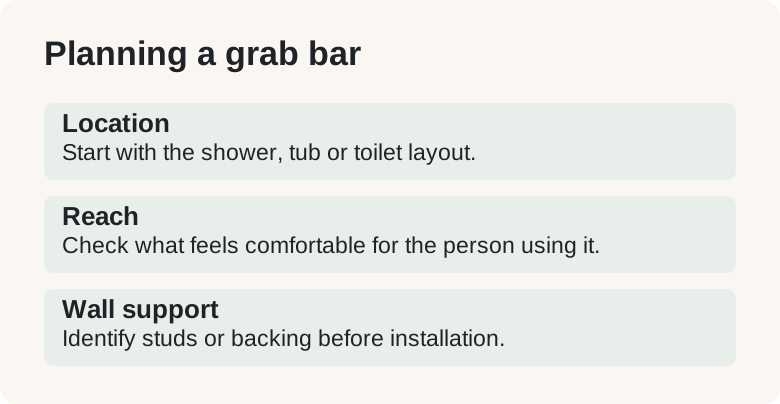
Horizontal grab bars go 33 to 36 inches above the finished floor, to the top of the bar (2010 ADA Standards, 609.4). A tub's second back-wall bar sits 8 to 10 inches above the rim. At home, fit the range to the person. Call a pro if there's no stud where the bar belongs, or the wall is tile or fiberglass.
What height should a grab bar be?
The published number is 33 to 36 inches, from the finished floor to the top of the gripping surface. That means the tile you stand on, not the subfloor. Measure to the top: mark the centre of a 1 1/4 inch bar at 34 inches and its top lands about 5/8 inch higher than planned.
The bar is round, 1 1/4 to 2 inches across, and stands 1 1/2 inches off the wall. A tighter gap pinches fingers; a wider one lets a forearm slip behind the bar in a fall. Each bar is designed for 250 pounds pushed at any point, so the screws and the wall do the real work, not the tube. That's why anchoring comes first when we install grab bars.
A towel bar is not a grab bar: its small screws tear out the first time someone leans on it. A stair handrail follows the slope of the stairs rather than a fixed height.
What height should a grab bar be in a shower?
Use the same 33 to 36 inches from the shower floor. Several horizontal bars all sit at one height, so a hand moving from wall to wall finds the next bar where it expects it.
In a 36 by 36 inch transfer shower, bars run across the control wall and along the back wall to 18 inches from the control wall. In a roll-in shower, no bar goes above the seat, and bars stop within 6 inches of the adjacent walls.
Most houses here have a stock 32 or 36 inch shower base instead. A common setup there is one horizontal bar on the long wall plus a vertical bar at the entry. The vertical one is ordinary practice, not an ADA requirement.
Keep every bar 1 1/2 inches clear of the valve and a hand shower's slide bar. Adding a handheld shower too? Plan both at once so they don't fight over the same studs.
Where do grab bars go around a bathtub?
The back wall gets two bars. One sits at 33 to 36 inches above the bathroom floor, for standing. The other runs 8 to 10 inches above the rim, for lowering yourself to the tub floor and getting back up. Each is at least 24 inches long.
At the faucet end, a 24 inch bar goes at the front edge; at the head end, a 12 inch bar.
In a house tub, the most-used bar is often a vertical one at the entry end, held while stepping over the rim. It isn't in the standard, but it's a common addition.
Many 1960s-80s west-side bathrooms still have the original tub, or one remodel's worth, with tile or a fiberglass surround. That surround often decides how a bar can be fastened more than the layout does. If it's coming out anyway, a bathroom refresh is the time to add bars.
Where do grab bars go by a toilet?
The side wall bar is at least 42 inches long. Its near end sits no more than 12 inches from the wall behind the toilet, and it reaches at least 54 inches out from that wall. The rear wall bar is at least 36 inches long, extending 12 inches to one side of the toilet's centre and 24 inches to the other. Both sit at 33 to 36 inches.
Seat height matters too: 17 to 19 inches in public restrooms, 15 to 19 allowed in homes. A taller toilet can help more than another bar; that swap sits under toilets, faucets and sinks.
Many hall baths have no side wall, just a vanity or tub beside the toilet. Then the options are a swing-up bar on the back wall, a safety frame that bolts around the toilet, or a bar on the tub wall if it's within reach.
How high should a vertical grab bar be?
The 2010 ADA Standards don't require a vertical bar next to a toilet. The figure many pages quote, an 18 inch bar with its bottom 39 to 41 inches above the floor and its centreline 39 to 41 inches from the rear wall, comes from the newer ICC A117.1 text that some states folded into their own codes. UpCodes shows it in the Virginia Accessibility Code 2017, section 604.5.1.2.
At home, a vertical bar is held at chest level to pull up or steady yourself. Place the bottom end near the standing person's wrist and the top near their shoulder, so the hand finds the bar halfway up or fully standing.
How do you anchor a grab bar where there is no stud?
Studs are usually 16 inches apart on centre. A 24 inch bar can catch two of them if you lay it out from the studs first and pick the bar length second. A 16 inch bar often can't reach two. An 18 inch bar set at an angle sometimes can.
With no stud in the right place, use a hollow-wall anchor rated for grab bars, never plastic plugs. Suction-cup bars can let go without warning; never put body weight on one.
Tile takes a carbide or diamond bit, slow speed, hammer mode off. Every screw hole gets silicone before the screw goes in, so shower water can't creep into the board behind. A one-piece fiberglass or acrylic surround flexes, so the bar needs backing behind it or an anchor built for thin shells.
The point where a homeowner should stop and call someone:
If the wall is opened for a tub-to-shower conversion, add wood blocking between the studs then. A few dollars of lumber makes every later bar position easy.
How do you pick the right height for one person?
The 33 to 36 inch range is wide on purpose. A simple test with painter's tape and a tape measure narrows it down:
- Barefoot in the dry tub or shower, the person lets one arm hang loose. The crease of the wrist is a comfortable height for a bar used to steady yourself.
- Sitting on the toilet or the tub seat, they start to push up. The bar belongs where the elbow is bent about 90 degrees at the start of that push.
- Tape the line on the wall and live with it for a day before anything gets drilled.
If two people of very different heights share the bathroom, set the horizontal bar for the shorter one and add a vertical bar long enough to cover both.
After a fall, an occupational therapist can assess the bathroom and the person together.
What does grab bar installation cost around Portland?
Most Portland-area jobs of this kind run $200-$350, typically about $300, with the bar included (market data, November 2026) . The other lines are jobs that often come up in the same visit.
| Job | Basis | Per | Low | Typical | High | Data |
|---|---|---|---|---|---|---|
| Grab bar installation | with materials | job | $200 | $300 | $350 | national, Nov 2026 |
| Raised toilet seat and safety frame | labour only | job | $100 | $175 | $300 | Portland estimate, Nov 2026 |
| Handheld shower head | labour only | job | $100 | $175 | $300 | Portland estimate, Nov 2026 |
| Non-slip treatment, tub or shower floor | labour only | job | $150 | $300 | $600 | Portland estimate, Nov 2026 |
More rates are on our pricing page. If the bars are part of swapping the tub for a shower, the tub-to-shower conversion cost guide covers the bigger number.