
Most doors that start sticking here in late fall have done one of three things: soaked up damp air and swelled, sunk on a top hinge that worked loose, or shifted along with the frame. Check the gap across the top first. Tight hinge screws cure a lot of these with no cutting at all. If yours still binds, we fix sticking doors.
I'm Slava, and I've done hands-on handyman work for 7 years. This guide is about reading the door before you cut anything.
Why do doors stick more in Portland's wet months?
Wood takes on water from humid air and gives it back when the air dries. It moves mostly across the grain, so a slab grows wider, and the jamb around it grows too. Paint on the faces slows this; a raw edge doesn't.
Here, the wet months are the sticking months. NOAA's 1991-2020 normals for Portland's airport station put 27.3 of the year's 36.9 inches of rain between October and March, about 74 percent, while July and August together get roughly one inch. So a door that fights you in January will often swing freely by August.
Most advice online is written for muggy summers and says to run the AC. Here the pinch comes in winter. Entry doors get cold rain on one face and heated room air on the other, which can bow a wood slab enough to catch at a corner .
How can you tell where a door is sticking?
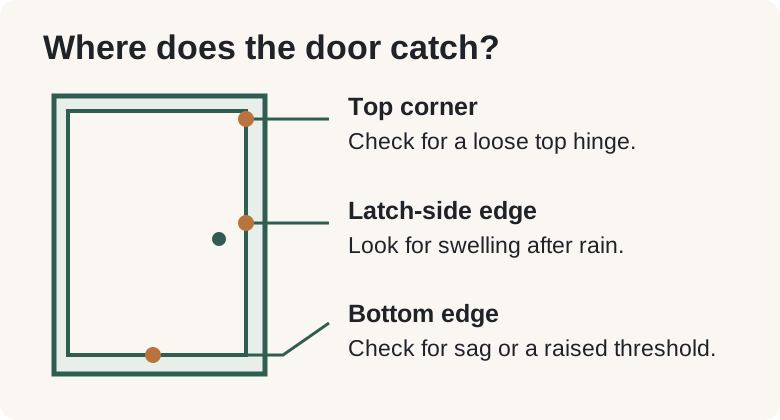
Close the door slowly and study the reveal, the strip of space between door and frame, across the top and down both sides. It should be even. Where it pinches to nothing is where the door catches, and a gap that widens at the far end shows which way the slab has tipped. Then look for paint worn through on the edge or jamb, or a polished arc on the floor.

| Where it catches | What it usually means | Try this first |
|---|---|---|
| Top corner on the latch side | The slab has dropped: top hinge loose or its holes stripped | Tighten or re-anchor the top hinge |
| Along the whole latch edge, worse after rain | The wood has swelled | Hinges first, then decide on planing |
| Bottom edge or the floor | Sag, or a new floor, rug or threshold | Check what changed underfoot |
| Hinge side, and the door wants to spring back open | Hinge-bound: leaves set too deep, or paint packed into the hinges | Clean or shim out the hinge leaves |
| Several doors at once, new cracks at door corners | The house itself has shifted | Read the section on bigger problems below |
How do you fix a door that sticks at the top?
Usually the top hinge has let go. It takes most of the pull as the door's weight leans away from the frame, so its screws loosen first. Lift the open door slightly by the handle and turn each top-hinge screw. One that spins without biting sits in a stripped hole: glue in a hardwood plug or dowel, cut it flush once set, and drill a new pilot.

A longer screw is the other lever. Replacing one short jamb-side screw in the top hinge with one that reaches the framing behind the jamb draws the slab toward the hinge side, which lifts the latch corner and reopens the gap where it rubbed .
A cardboard shim behind a hinge leaf tilts the door too, but behind the wrong hinge it just moves the rub to the opposite corner. Plane the top only when the hinges are solid and the corner still drags .
What if the door sticks at the bottom or drags on the floor?
Inside, ask what changed under it. New laminate, a thicker rug or a taller threshold can make an unmoved door drag. The cure is trimming the bottom with the door off and a saw on a straight guide. Door makers cap how much can come off: Simpson's instructions allow at most 1-1/2 inches from the bottom and 1/2 inch from the top.

Outside, a slab scraping the sill plus a spongy jamb near the floor is a different story. Rain collects at the jamb's foot all winter, and the wood can decay under sound-looking paint. If a screwdriver tip sinks into the lowest few inches, that's rot, and it calls for rotted door frame repair, not an adjustment.
Should you plane a swollen door now or wait for summer?
Planing in January sizes the door to its wettest state, so by August the gap is too big: light along the top, a draft at the latch. Planing in August leaves too little room for winter. The middle course is to tighten the hinges now and, if it still binds, shave off only what it takes to close today .
Simpson, one door maker, tells installers to leave about 3/16 inch for swelling when a door goes in fully dry. That's their instruction, not a code. Seal any bare wood the same day: Simpson's finishing instructions call for the top, bottom and side edges to get every coat the faces get, all six sides, or the warranty is void. A bare planed edge swells right back before spring.
As for which edge, the latch side is normally cut on a slight bevel, and planing it changes that angle, so wood tends to come off the top or the hinge side instead .
Many homes in Cedar Hills, Cedar Mill and Beaverton were built before 1978, and planing or sanding a painted edge there disturbs paint that may contain lead. Lead-paint disturbance is on our list of what we don't do .
Why does a painted door stick to the frame?
Sometimes the wood is fine and the paint is the trouble. Fresh paint on the edge and the stop can bond while the door sits shut, and in a cool, damp house it stays tacky longer than the can says. Leave a newly painted door cracked open until it hardens.
On older doors, decades of coats on the edges and in the hinge leaves eat the clearance. Scraping back and repainting thinly gives it back, though in a pre-1978 house old paint should be tested first. Door makers also use "sticking" for the shaped profile around a panel, as in "shaker sticking"; that meaning isn't the subject here.
When is a sticking door a sign of something bigger?
Watch for several doors catching at once, fresh diagonal cracks from the corners of door openings, a top gap that closes again weeks after a hinge fix, or a door that sticks all year.
Many 1960s-80s west-side houses sit over crawl spaces, and their floor framing can shift a little between seasons, sometimes enough to pull a door out of square. If the framing or foundation is moving, a structural specialist should look first, or the door will drift out again. We can set the door right afterward .
When the slab itself has split, peeled or gone soft along the bottom rail, a new door is usually the better spend.
What does it cost to have a sticking door fixed around Portland?
These are Portland-area market ranges from November 2026, labour only, with hinges, wood and paint billed separately. They are not our quote .
| Job | Typical | Range | Unit |
|---|---|---|---|
| Adjusting a sticking or sagging door (plane, shim, rehang) | $250 | $150 to $400 | job |
| New hinges or stripped screw holes repaired | $200 | $120 to $300 | job |
| Door that won't latch or close realigned | $200 | $120 to $300 | job |
| Door painted or refinished | $300 | $150 to $600 | per door |
| Split jamb or damaged casing repaired | $450 | $250 to $900 | job |
| Rot cut out of the frame or threshold | $800 | $400 to $1,600 | job |
Tightening the hinges, planing one edge and sealing it usually fits inside the first row, around two hours of work in the market estimate . How a handyman's time adds up on the bill is explained in our guide to handyman cost per hour, and the full list of door work is on the door repair page.
Is it different for sliding, pocket, closet or fiberglass doors?
Steel and fiberglass slabs barely swell, so check the hinges, frame or weatherstrip, and never plane fiberglass. A new entry door can feel stiff until its seal settles .
A dragging patio slider usually has worn rollers or a gritty track: $200 to $600 around Portland, about $350 typical, labour only . More on French and sliding doors.
Pocket and bifold closet doors stick when rollers jump the track. Pocket door repair runs $250 to $900, about $450 typical , and bifold or closet door work $150 to $600, about $300 typical, both labour only .