
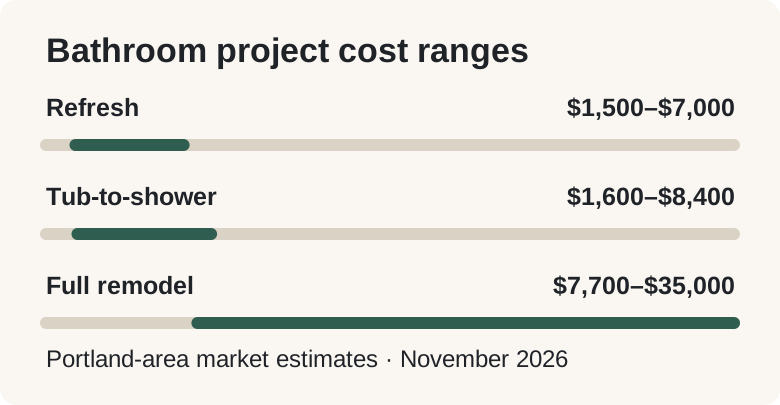
For one bathroom around Portland, a full remodel usually costs $7,700-$35,000 including materials, and $15,100 is the typical ticket (local market figures, Nov 2026) . A cosmetic refresh that leaves the tub and pipes alone is $1,500-$7,000. Pulling the tub and building a walk-in shower costs $1,600-$8,400. Layout, square feet of tile, rot under the floor and permits push the number up or down.
What our crew handles on these jobs, and who does the pipes and wiring, is on the bathroom remodel page. This guide sticks to money. I'm Slava, and I wrote it for anyone holding a bid and wondering whether it's reasonable.
What do Portland bathroom remodels cost?
Local prices fall into three bands. All three come from the single price sheet we keep, dated November 2026. They're the market's numbers per bathroom, materials in, and not a quote from us.
| Tier | Typical | Low to high | Scope |
|---|---|---|---|
| Refresh | $3,500 | $1,500 to $7,000 | new paint, caulk, vanity, mirror and accessories; the tub and pipes stay |
| Tub-to-shower | $3,200 | $1,600 to $8,400 | old tub removed, walk-in shower built |
| Full remodel | $15,100 | $7,700 to $35,000 | new tile, flooring, vanity, and a tub or shower |
Some Portland design-build firms open their pricing several times higher. They're selling moved walls, designer hours and custom finishes, which is another kind of project. National cost sites lean low, since they blend in regions where labour is cheaper.
For planning, the full-remodel band is roughly where a modest job that keeps its footprint lands here.
How much is a bathroom refresh, and where does it stop?
Expect $1,500-$7,000 with materials, with $3,500 as the usual figure (Nov 2026 market sheet) . Our sheet plans on roughly three days of labour, and materials make up roughly 35 % of the bill.
A refresh fits a room where the tub, the toilet position and the tile are fine, but everything looks worn. Yellowed caulk, a vanity whose bottom has swelled, scuffed paint, a towel bar hanging off a stripped anchor. Many Bethany homes dating from the 1990s and early 2000s have bathrooms at exactly that stage.
It stops short of a new tub, opening any wall, or rerouting a pipe. Add any of those and the job is priced as a remodel. Our bathroom refresh page lists what's included.
What does a remodel cost if nothing moves?
When the footprint stays, the price tends to land close to the $15,100 typical figure, not at either end of the band . Footprint here means the toilet, the drain for the tub or shower, and the vanity all keep their spots. The surfaces and fixtures are what get replaced.

If your only real gripe is the tub, price a tub-to-shower conversion first. The market sheet puts it at $1,600-$8,400 including materials , often a fraction of a whole-room job.
Cedar Mill's housing is mostly 1960s and 70s, and Beaverton is full of ranches and split-levels built between the 60s and the 90s. Their hall baths tend to be small, and the framing already fixes where each fixture sits. Leaving those spots alone is what keeps most bills near the center of the band.
Why is a full gut so much more expensive?
Because most of the hours go into work that's buried by the end. A rough list:
- Relocating a toilet or drain means cutting the floor open, running new pipe, and pulling a plumbing permit.
- A tiled shower has to be waterproofed under every square inch of tile, and rushing it leads to leaks.
- Every extra square foot of tile adds cutting, setting and grout time.
- Walls opened to the framing need rebuilding before finish work starts.
- A new fan or light circuit adds an electrician's visit.
The shower or tub area, with its walls, pan and membrane, is normally the biggest slice of the budget. It's also the worst spot to save money.
Gut jobs drift toward the top of the band, close to $35,000. Beyond that you're paying for a new floor plan and custom design.
What share of a bathroom budget is labour?
Our market sheet splits a full remodel at roughly 40 % materials, 60 % labour, and plans about 100 working hours per room.
Single jobs, priced one at a time
Market data, November 2026. Some rows include materials, some are labour only, so check the last column.
| Job | Typical | Low to high | Includes |
|---|---|---|---|
| Tile a bathroom floor | $2,000 | $800 to $4,000 | materials |
| Fix a tub or shower surround | $700 | $300 to $1,500 | labour |
| Rake out and regrout | $700 | $300 to $1,500 | labour |
| Replace soft subfloor | $1,200 | $500 to $3,000 | labour |
| Hang a shower door | $500 | $300 to $900 | labour |
| Paint one room | $800 | $400 to $1,700 | materials |
| Towel bars, hooks, paper holder | $250 | $120 to $450 | labour |
| Grab bars | $300 | $200 to $350 | materials |
Adding the rows doesn't give you a remodel price. Done as one project, tear-out, prep and scheduling are shared, so each item costs less than it would as its own trip.
plumbers and electricians handle those parts, and they bill separately. In a pre-1978 house, painting falls under the lead rules covered below. All our prices sit on our pricing page.
What surprises turn up after demolition?
The usual one is a spongy subfloor right at the toilet flange or along the front of the tub. Pull off old tile or a leaky surround and you may also find rotten studs, or a little surface mould where water got behind failed caulk.
Replacing subfloor is $500-$3,000 for labour alone, usually around $1,200 (Nov 2026 market sheet) . Cleaning a small mould spot, fixing what caused it and repainting runs $250-$1,000 labour, typically $500 . That covers small surface spots, not remediation.
Plenty of homes on the west side have crawl spaces underneath. A slow drip at a toilet or tub frequently shows up from below before you'd spot it upstairs, as a dark, soft area on the plywood. If you have a crawl space, go down with a flashlight before anyone bids. What you see there helps both you and the contractor.
Wet winters are why the fan matters, too: steam that stays in the room is what slowly rots a floor in this climate. Hold some money back for things nobody can see yet.
How do Oregon's rules change a bathroom budget?
They mostly add line items and wait time. How old the house is decides which ones you'll see.
Permits. Oregon's building codes division doesn't require a building permit for tile, paint, cabinets or countertops. Altering pipe that's concealed in a wall, a ceiling or below the floor takes a plumbing permit. Wiring that's added or changed takes an electrical permit. Washington County's plumbing FAQ agrees for remodels where existing pipes get relocated, and Portland's bathroom page says many remodels only need trade permits. A remodel that moves pipes therefore carries fees and inspection delays that a refresh skips. Our area spans more than one permit office, so fees depend on your city or county. Have each bidder show permits as a separate line.
Lead paint, homes from before 1978. under state guidance rules, indoor work that disturbs more than 6 square feet of paint in a room is lead renovation. Stripping a painted bathroom wall passes six square feet quickly. A lot of Cedar Hills tract homes from the 50s and 60s keep the bathrooms they were built with. We explain our position on what we don't do.
Asbestos, homes from before 2004. DEQ wants an accredited inspector's survey before renovating houses older than 2004. Friable asbestos has to be handled by a abatement firm. DEQ names vinyl floor tile as a nonfriable material, and that work needs a notice filed with DEQ at least five days out. Many homes here, including plenty in Bethany, predate 2004. Put the survey, plus any abatement, in the budget as a line that happens before tear-out.
Can you redo a bathroom for $10,000?
Usually, as long as nothing moves. A budget ladder built from the same market rows:
- Up to about $7,000: a refresh (that band's ceiling), or replacing the tub with a shower, which goes as high as $8,400.
- Roughly $7,700 to $15,000: the lower end of full-remodel pricing, enough for a same-footprint room with mid-priced tile and fixtures.
- Over about $15,000: more tile, a tiled shower, floor repairs or relocated pipes, climbing toward $35,000.
So ten thousand dollars typically buys new finishes and fixtures where the old ones stood, not a new floor plan.
How should you compare two bathroom bids?
Make sure both bids describe the same job before comparing totals. Each should say whether the layout changes, the tile square footage, tub or shower, and which items are allowances rather than fixed.
Then ask for these as their own lines:
- tear-out, and who takes away the debris;
- subfloor repair, by the sheet or as a set reserve;
- permits;
- the asbestos survey, if the house predates 2004.
Oregon requires a contract in writing for home jobs above $2,000. If a smaller job creeps over that amount, the contractor has five days to put one in writing, plus the state's three required notices on liens, consumer protection and procedure. Our contract guide walks through it.